

Balletcore: The aesthetic of obsession
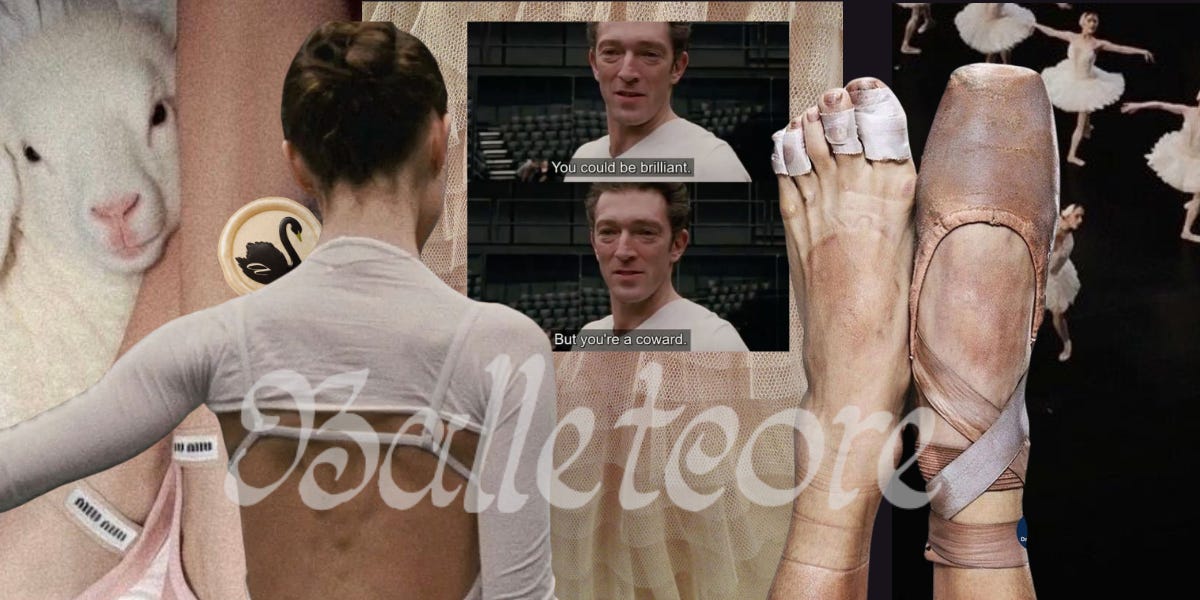
The 5 Core Competencies of Balletcore are:
Corrected Posture, Soft Palette, Textured Layers, Functional Detail, and Ritualized Repetition.

The first thing you feel is jealousy. The second thing you feel is that jealousy is the wrong word.
You’re not looking at someone who has something you want. You’re looking at someone who has become something you didn't know was possible.
There’s a sharp thrill found inside of mastery, a satisfaction found in relentlessly asking more of yourself. Practicing until your muscles elongate like a daddy long legs, feeling your toenails stripped backwards, your muscles broken and wrapped around your finger. A broken doll whose fragility is merely superficial, a mirage, twirling in endless perfect circles in front of an infinity of mirrors.
We envy it, we hate it, it disgusts us, it moves us, we want to crawl inside the skin it’s in and feel the glory for ourselves.
Balletcore is the only aesthetic that punishes you for wanting it.
Balletcore has devoured over one billion views on TikTok. The average view lasts roughly 39 seconds, which means a word that didn’t exist before 2022 has consumed nearly 1,300 years of continuous human attention.
This is different from every other aesthetic fascination because it has so little to do with the actual clothes. We crave the body, the ideal, the fantasy that such a devoted discipline is waiting to be unlocked inside of us. Dormant but for the right pair of leg warmers, the right note of Chopin.
No one who buys the ribbon flats has ever bled through a pointe shoe. Ballet represents something most people will never have: a body that does exactly what it’s told.
This fixation did not begin with Aronofsky, and it’s not going to end with TikTok. Edgar Degas painted the Paris Opéra Ballet obsessively for over thirty years, producing more than six hundred works of the same subject: ballerinas being corrected. Not on stage, fantastically soaring through the air, but at the barre. Backs straightened, positions adjusted, bodies measured again and again and again. The paintings are beautiful because the discipline is visible. That’s what transfixes us. Balletcore is not a trend that found an audience. It is a fixation that found a hashtag.
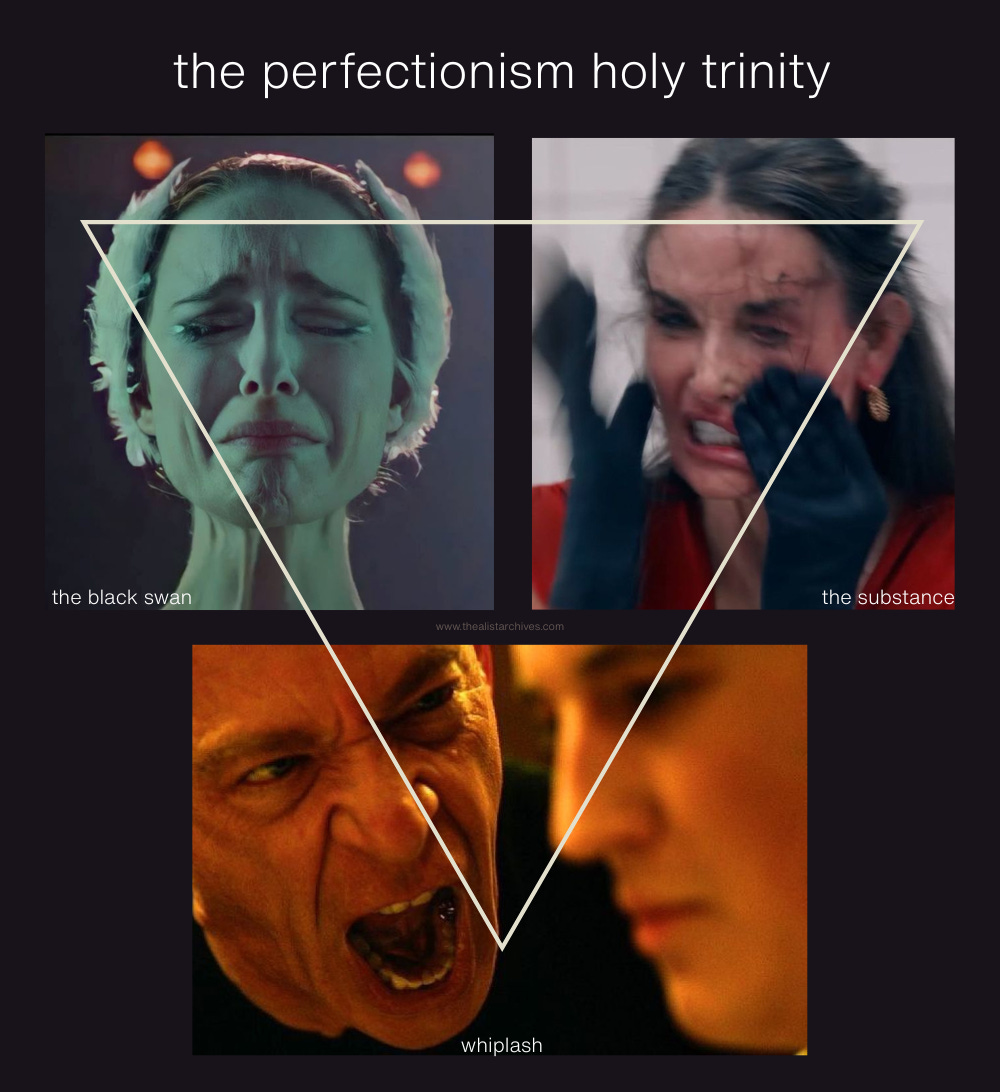
Black Swan arrived in 2010 and was toe-curlingly brutal, completely impossible to look away from. Nina’s all-consuming obsession with perfection was written into her wardrobe: pink stockings over knit leg warmers, purpled bruises and gauzy bandages, a sick, accessorized beauty where her wounds were ornamental, proof of her unwavering effort, commitment. Natalie Portman was beautiful, she was grotesque, she was magnetic in her transcendent desire to seduce perfection into the palms of her hands.
Black Swan proved what Balletcore still hasn’t absorbed: the embodiment comes from an internal drive, or it doesn’t come at all.


On March 8, 2022, Miuccia Prada sent a model down the runway in satin ballet flats paired with leg warmers, and as a society we decided that this was the only shoe that had ever mattered. By the end of that year, the Lyst Index recorded a 1,100% spike in searches for the flat, naming it the hottest product of 2022. Miu Miu shoe sales were up 200% from the beginning of that year alone.
The number itself isn’t remarkable. A good runway can cause nearly anything to have a good 15 minutes of fame. What’s unique about Miu Miu is that it was the clothes that went viral, not the celebrity wearing them. This is extraordinarily rare in an era where product placement drives cultural relevance. In this corporate realm of reality, this product created its own gravity.
Miu Miu secured the title of hottest brand of both 2022 and 2023, fueled entirely by the satin flat. Sales were up 50% by Q4 of 2023. A single shoe. A single runway. Three years of compounding financial consequence.
The greatest contradiction? The Miu Miu flat is not a ballet shoe. It’s the suggestion of one.
Satin, a ribbon detail, a low profile, the silhouette of discipline without a single demand of it. Miu Miu understood before the rest of the industry did that what women wanted was not ballet. What they wanted was the feeling of having chosen something that precise, that considered, something that said: I know exactly who I am and I dressed accordingly.
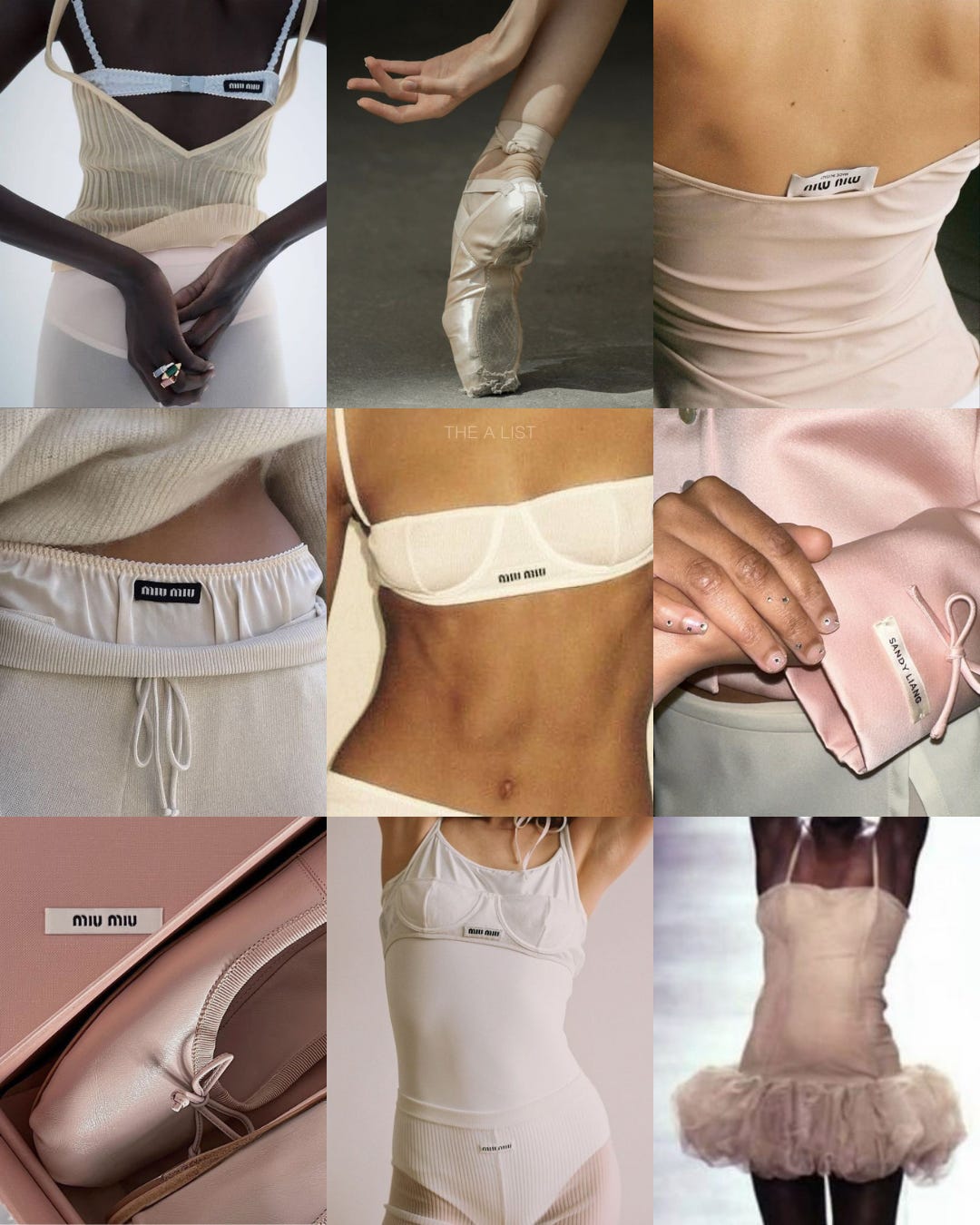
In recent months, the most telling detail of the Balletcore wave is how many designers have cast professional dancers instead of models. Alainpaul, who trained at the Opera Marseille, built his entire Paris debut around rehearsal studio attire. Tiler Peck, principal dancer of the New York City Ballet, closed the Adeam show en pointe. When NikeSKIMS released its Spring 2026 collection, LISA from BLACKPINK was the star, shot alongside professional ballerinas, without a Kardashian in sight. A brilliant decision, and a deliberate one, to show rather than tell that the brand understood this as something deeper than a trend. The body was always the subject. The clothes? Supporting characters.
If you already know which archetype is driving what you reach for,
the deep dive is here.
The ballet body is not a body type. It is the manifestation of obsession, repeated until you change forms, and there are five specific things a dancer installs before that transformation becomes visible, none of which have anything to do with what she’s wearing.
THE AESTHETIC METHOD
What you are about to read is not a styling guide. It is a behavioral sequence. Each phase builds on the last, and the order is not arbitrary.
A dancer does not begin with performance. She begins with the body. Then the eye. Then the layer. Then the edit. Then the repetition that makes all of it automatic. You are going to do the same thing, in the same order, for the same reason: because skipping phases is how you end up with the clothes and not the thing the clothes are supposed to signal.
The psychological principle underneath all five phases is enclothed cognition: The research finding that wearing clothing associated with a specific identity changes your cognitive performance and behavior, not because of how others see you, but because of how you experience yourself while wearing it. You are not dressing “as a dancer”. You are installing the psychology of someone who has been corrected so many times that the correction became the posture. There is a difference between those two things, and by Day 30, you will be able to feel it.
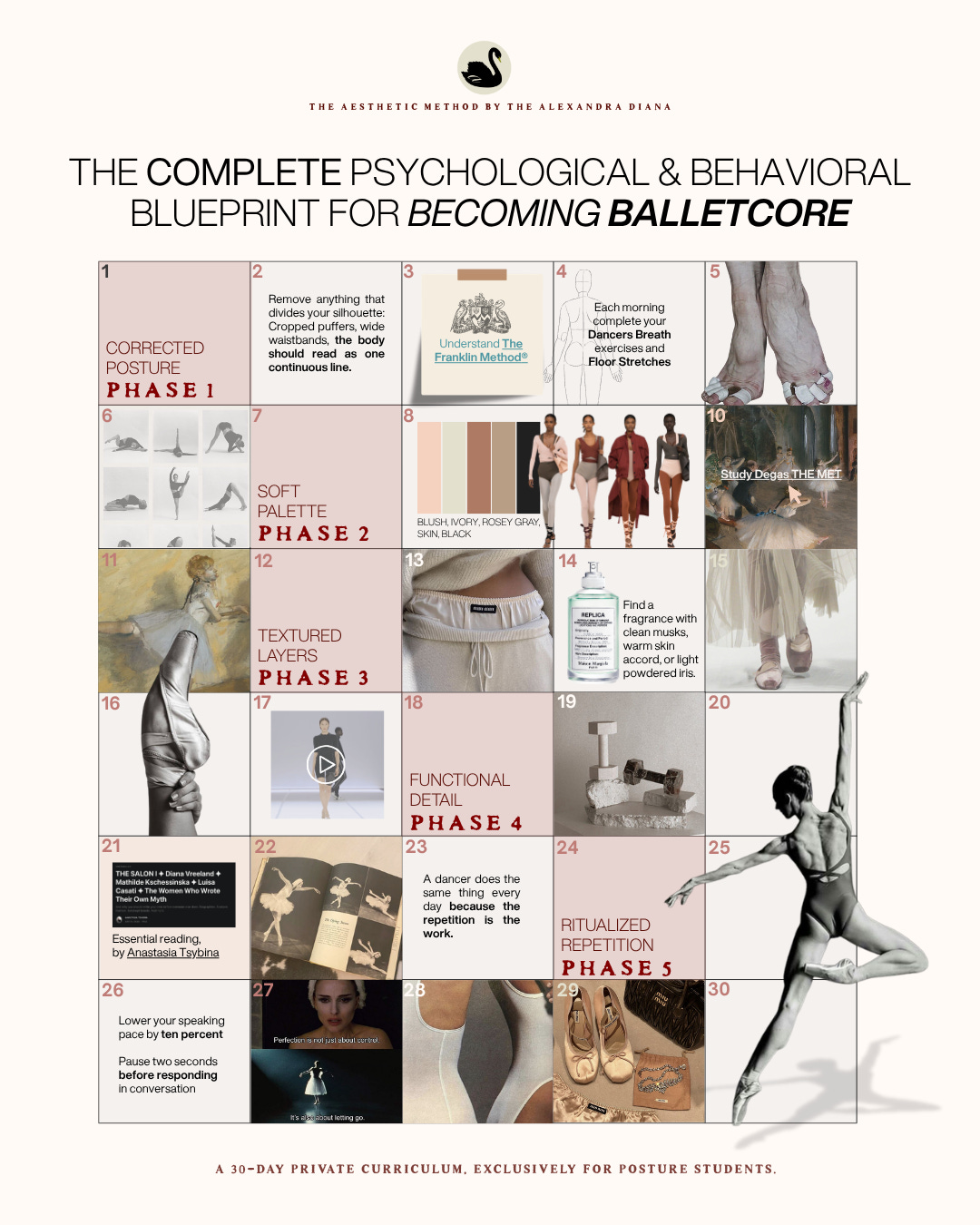
Download the PDF version with all linked resources here ↓

Phase I: Corrected Posture, days 1-6
A trained dancer’s posture is not natural. This is the first thing to understand. It was deconstructed from normal and recreated through thousands of corrections, administered by someone standing behind her, whose entire job was to see what she could not see herself. The result is not good posture. It is authored posture. A body that has been deliberately rebuilt to communicate something specific before it moves.
This is where Balletcore begins. Not in the flat, not in the leg warmer. In the spine.
Wardrobe Installation
Introduce one piece that clearly defines your waist. A leotard worn as a base layer, a wrap top, a fitted knit. The specific item matters less than what it does: it makes the silhouette impossible to hide inside.
Remove anything that divides your body horizontally. Cropped puffers, wide waistbands, anything that interrupts the vertical line. The body should read as one continuous line from shoulder to floor. If something breaks that line, it does not belong in this phase.
Behavioral Installation
Practice the stillness of someone who has been trained to hold a position. When you stop moving, stop completely. No shifting weight, no reaching for your phone, no adjusting. Complete stillness is not passive. It is the most controlled thing a body can do.
Stand with the crown of your head reaching toward the ceiling, not your chin. There is a difference. The chin leads with effort. The crown leads with length.
Sit without leaning back into your chair. Shoulders back and down, not up and forward. If you have to think about this, you are building the neural pathway. By Day 6, you will stop having to think about it.
Study
Postural Alignment with The Franklin Method® — understand why a position works, not just how to hold it. Understanding the mechanism is what makes the correction permanent.
Psychological Anchor
The research on embodied cognition shows that postural changes precede psychological ones. You do not stand like that because you feel like that. You feel like that because you stood like that. The posture is not the result of the identity. It is the beginning of it.
Phase II: Soft Palette, days 7-11
Balletcore’s palette is blush, ivory, rosy grey, skin, and black. This is not a mood board preference. It is a behavioral decision with a specific psychological function.
A restricted palette eliminates the daily negotiation between who you are and what you are reaching for. A dancer in her studio does not choose her colors each morning. She reaches for what the discipline requires. The removal of chromatic variety is the removal of a decision, and the removal of that decision is the beginning of a ritual.
Wardrobe Installation
Remove high-vibrancy color from daily rotation for the duration of this phase. Not forever. For eleven days. Notice what it changes about how you move through your wardrobe in the morning.
Avoid stark bright white. Avoid high contrast. Every color in an outfit should belong to the same family. Like goes with like. The effect is not monotony. It is coherence, and coherence reads as intention.
Environmental Installation
This aesthetic is not only clothes. Replace bright overhead lighting with warm lamps in the space where you get dressed. The quality of light changes what you see, and what you see changes what you reach for. A dancer’s studio is never fluorescent. There is a reason for that.
Study
Edgar Degas, through the Metropolitan Museum of Art’s digital collection. Do not look at the dancers. Look at the palette. Notice that the color is never scattered. Every value in the frame belongs to the same temperature. This is what chromatic coherence looks like at its highest expression, and it was painted in the 1880s with the same logic you are installing in your wardrobe today.
Psychological Anchor
Decision fatigue research, first established by Roy Baumeister in 1998, shows that every choice made draws from a finite pool of cognitive resources. As that pool depletes, the quality of subsequent decisions deteriorates. A restricted palette does not limit your options. It eliminates a category of decisions entirely, which preserves cognitive capacity for everything else.
Phase III: Textured Layers, days 12-17
A dancer wears layers because her body requires them. The wrap cardigan exists to keep the muscles warm between exercises. The leg warmer protects the Achilles tendon before it is needed. The knit short covers what the leotard exposes without restricting movement. Every layer has a thermal or functional reason, and the accumulation of those reasons produces a look of such specific, considered complexity that it reads as a visual language.
You are going to borrow that language, and then you are going to understand it well enough that it stops being borrowed.
Wardrobe Installation
Introduce a wrap cardigan or crossover knit as a daily layer. Not a substitute for a top. A layer over one. The distinction matters because the silhouette requires depth, not replacement.
Add one piece of visible textural contrast per outfit. Ribbed knit against matte satin. Structured cotton against sheer jersey. Lightweight wool against stretch fabric. The contrast must be visible and it must be intentional. Two textures that accidentally ended up together is not the same thing as two textures chosen for what they do to each other.
Remove any synthetic that holds its own shape. If it maintains a silhouette without you inside it, it does not belong in this aesthetic. The clothes should follow the body, not replace it.
Introduce sheer as a layer over something opaque, in the same palette. This is the most specifically Balletcore construction available to you outside a studio. It’s also the most frequently done wrong. The sheer must be in the same color family as what is underneath it.
Sensory Installation
Find a fragrance with clean musks, warm skin accord, or light powdered iris. Your scent in this phase should feel like something that has always been there, not something applied. A dancer’s scent is effort and warmth and something clean underneath both. Find yours.
Study
Alainpaul’s Paris debut collection. He trained as a dancer at the Opera Marseille and built every look around rehearsal studio attire. Watch the layering specifically, not the garments. Each look has three or four things happening and none of them compete. This is the visual argument for everything this phase is asking you to install.
Psychological Anchor
A 2010 study published in Science found that physical weight directly influences social judgment. Participants holding heavier clipboards rated job candidates as more serious and better qualified than those holding lighter ones. The association between weight and significance is not metaphorical. It is neurological. The textural complexity of this phase is not decorative. It is the physical signal that registers as commitment before a word is spoken.
Phase IV: Functional Detail, days 18-23
The ribbon on the ballet flat was designed to tie around the ankle and hold the shoe in place during turns. The bun exists because a dancer cannot have hair in her face. The wrap skirt covers the leotard between rehearsals while allowing full range of motion. The leg warmer keeps the Achilles tendon warm before it is needed.
None of this is decoration. All of it became beautiful because of what it was doing.
This is the phase most people resist, because it is not about adding. It is about understanding why things are removed, and removing them.
Wardrobe Installation
Remove the acrylic nails. A dancer’s hands are an instrument. Anything that interferes with their precision is removed.
Remove chunky, stacked, or layered rings.
Remove anything with visible branding or graphic text.
Remove anything that makes sound when you move.
Remove overly decorative hair accessories.
What remains should be one deliberate thing, or nothing. A single heavier chain at the collarbone. A stud. A ring chosen because of what it means, worn alone because anything beside it would dilute the meaning. Balletcore adornment does not seek attention. It tolerates projection.
Behavioral Installation
Keep your chin level when you are referenced in conversation. Do not look down when someone addresses you directly. Do not play with jewelry while speaking. Speak one sentence fewer than you normally would, and let the silence after it do the work that the extra sentence was trying to do.
Psychological Anchor
Research on habit and identity published in Frontiers in Psychology found that individuals whose habits are strongly linked to their sense of identity show higher cognitive self-integration and stronger self-monitoring. When every detail of what you are wearing has a deliberate reason, you are not performing discipline. You are installing it. That installation is what the aesthetic reads as from across a room.
Phase V: Ritualized Repetition, days 24-30
A dancer does the same thing every day because the repetition is the work. Not preparation for the work. The work itself. The barre exercises she did at eight years old are the same exercises she does at thirty-eight. The correction her teacher gave her in year one is the correction she is still installing in year twenty. The repetition is not a failure to progress. It is how the progression becomes permanent.
This is the phase that determines whether Balletcore becomes your aesthetic or remains a thirty-day experiment.
Wardrobe Installation
Repeat the same silhouette five times in one week. Not the same outfit. The same silhouette. The same vertical line, the same palette family, the same textural logic. Rotate the specific pieces. Keep the architecture identical.
Rotate your shoes properly. Do not wear the same pair two days in a row. A dancer rotates her pointe shoes because the material needs to recover. The logic applies to every shoe you own.
Stop shopping entirely for seven days. Do not scroll style content. The dancer does not seek inspiration during the practice of the practice. She arrives at class and does the work. External influence during this phase works against what you are trying to install. The aesthetic cannot become yours if you are still looking at someone else’s.
Behavioral Installation
Lower your speaking pace by ten percent. Not your volume. Your pace. A dancer moves at the speed the music requires, not the speed her nerves produce.
Pause two seconds before responding in conversation. This is not a social strategy. It is the behavioral equivalent of the breath a dancer takes before she moves. The pause communicates that what follows was chosen.
Remove filler words. Like, sort of, kind of, you know. Every filler word is a place where you decided not to commit to what you were about to say. A dancer does not almost do a turn.
Psychological Anchor
As a ritual is repeatedly performed, the neural pathways within the basal ganglia strengthen. Behavior transitions from a conscious, effortful action to an automatic, reflexive one. What required deliberate effort on Day 1 requires no conscious thought on Day 300. This is how identity is installed. Not decided. Not declared. Repeated, until the repetition becomes who you are.
YOUR FINAL RUNWAY
You have thirty days of installation behind you. What follows is not a checklist. It is a reckoning.
Curate one complete look. Photograph it in low natural light. Then ask yourself the questions a teacher would ask, standing behind you, seeing what you cannot see:
Is there a clear vertical line from shoulder to floor, or does something interrupt it, and if something interrupts it, why is it still there?
Is every color in this look cohesive, or did you make one exception, and if you made an exception, what were you hoping it would do?
Are there at least two textures, and do they have different functions, or did you layer them because they looked interesting together, which is not the same thing?
Can you name what every detail is doing? If you cannot name it, you chose it for attention. Take it off.
Has anything in this look been added for the sake of being noticed? A dancer is always being watched. She does not dress for it. She dresses in spite of it.
If you wore this exact look every day this week, would it feel like a choice by Friday, or a uniform? A uniform is what happens when repetition replaces thought. A choice is what happens when repetition becomes identity. You are after the second one.
The difference between someone who tried Balletcore and someone who became it is not the clothes. It was never the clothes. It is whether your discipline outlasted the thirty days.
You already know which one you are.
Your archetype determines which phase you’ll resist.
With great personal aesthetic,
Alexandra Diana, The A List
