

The best disappearing acts all have one thing in common: the audience never sees it coming.
For three weeks, she’d been preparing. Tags and packing peanuts cluttered the floor as she delicately stepped over the cheap metal shipping hangers to examine her look in the full-length mirror. She had already sent back two dresses that looked nearly identical, as well as a litany of ugly step-sisters who were cursed with the wrong neckline, poor coloring, or worst of all, translusence. Finally, she had found a winner! Silky and midnight blue, her dress swept across the floor over her toes, spaghetti straps dainty resting on her shoulders. Open-toed heels revealed a light pink pedicure (shade: bubblebath), and her hands closed around a small purse she planned to keep tucked away for the majority of the evening.
As we walked into the venue, air-wrapped curls bouncing inside of her Bottega-esque earrings, I saw her have what looked like a thousand tiny spasms: a flurry of micro-adjustments and preening, one last chance at a perfect first look, like a general preparing to walk into a glamorous battle.
We were barely inside for 5 minutes when an acquaintance came whipping across the hall in our direction. Over the moon, she grabbed my friend’s forearm and with stars in her eyes she squealed Ohmygod! We’re twins!
For the first time in nearly a month, my friend relaxed like a limp marionette, shoulders dropping with relief and genuine delight. All that work, all that research. Standing in front of her was real, social proof that her efforts hadn't been in vain. Her body language morphed into someone lighter, happier, she seemed like she was finally herself again.
And that’s when I saw it.
Right before my eyes, with a masterful slight-of-hand, she preformed the greatest magic trick I’d ever seen.
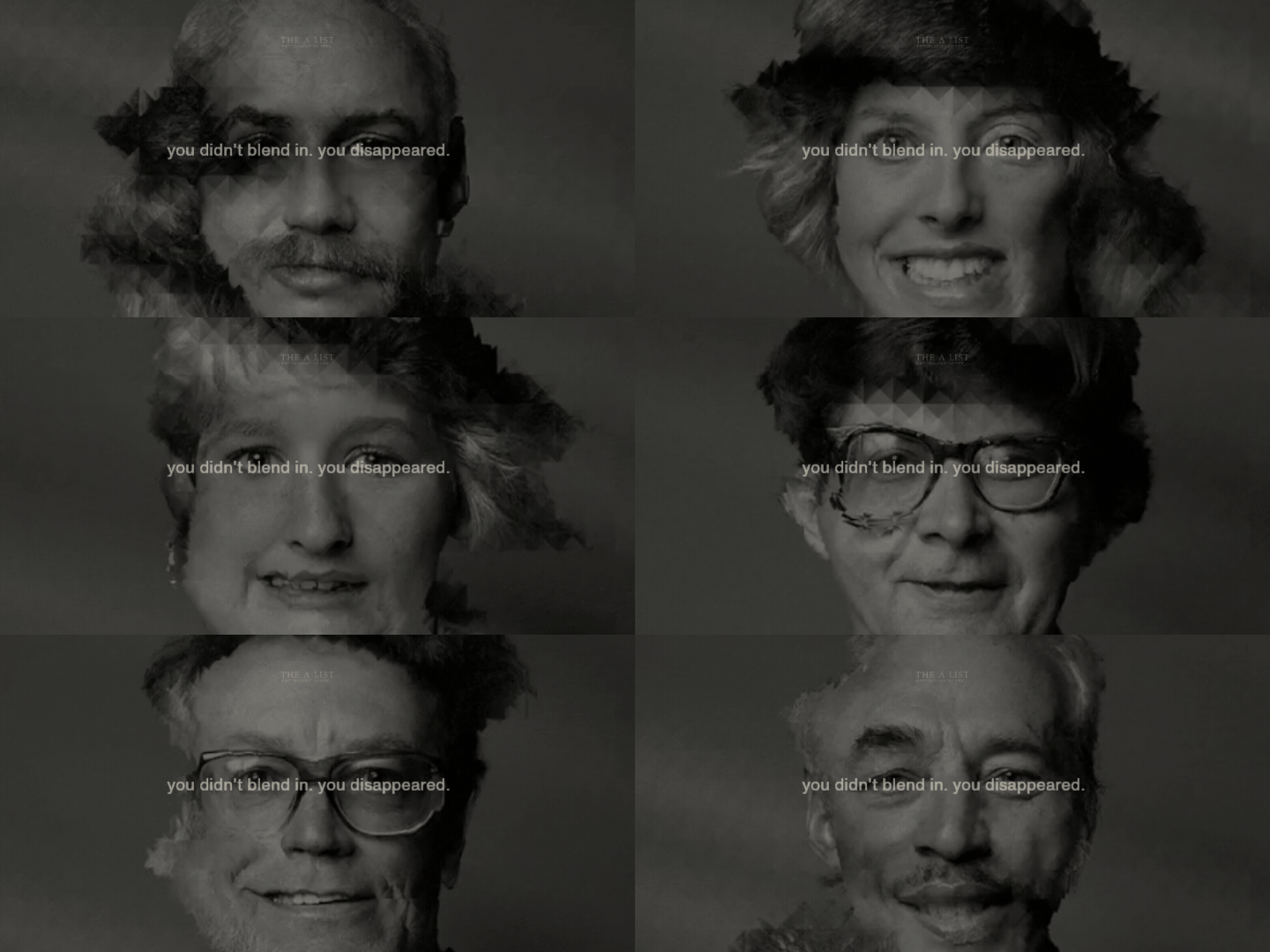
She disappeared.
Every person carries two competing biological needs:
the need to fit in and the need to be seen. We satisfy these opposing needs by identifying with groups and occasions that make us feel like we belong, while still feeling like ourselves. The issue is that fitting in almost always requires reducing your willingness to be seen as different, and most people make that trade without knowing they made it.
This is exactly what happened to my friend. She belonged so completely to the occasion she could not be individually located within it.
When you outsource your opinion to the masses, you stop dressing as yourself and start dressing as a consensus. You are not making a choice based on what makes you proud. You are making a choice based on what is most likely to go unquestioned. The algorithm is a compelling force precisely because it makes you feel like you are doing something right by following it. But the algorithm has no distinct face, no specific presence. It cannot be chosen, championed, or remembered.
My friend didn’t disappear because she failed. She disappeared because she succeeded at becoming the average of everyone else’s decisions.
Each of The 9 bend to this pressure differently.
The Architect edits until nothing controversial remains, so refined they lose their signature all together. The Anchor wears what worked five years ago because it still ‘works’, which is the problem. The Heir defers to what the occasion expects instead of what they believe would be best. The Seeker picks something specific, loses their nerve, and arrives in something safer. The Proxy (my friend) arrives as a carbon-copy and mistakes it for personality. The Performer recreates whatever made them feel most complimented instead of trying something new. The Sleepwalker would fold under pressure and refuse to attend, and The Shadow would strip away all sense of self to become deliberately unreadable. The most dangerous thing about this is that it feels like a choice.
She is liked by everyone and can be described by no one.
She’s the person whose name someone snaps their fingers trying to remember. Her social equivalency is the same as a file marked Case Closed! All relevant information has been collected and there’s nothing new to report. Remarkable things don’t happen to her because she’s not the first, second or third person that anyone thinks of. She looks like everyone else and because of this, she’s passed over every time.
the full portrait of this position, what produced it and what moves it
Your assignment
The next time you get dressed for something that matters, close every tab. Put the phone down. Get dressed the way you would if nobody who mattered would ever see you, and then walk directly into the room as if each one of them were there.
You’re going to have an overwhelming sensation that what you selected is too much. That feeling is not a warning. It’s the uncomfortable sensation of making a decision that has not been pre-approved. Keep going. When you land on your look, do not remove or edit anything before you leave. Whatever you chose in private, you wear in public.
This is where it gets interesting. When what you’re wearing is congruent with who you actually are, your body will naturally respond before anyone else does. Your posture will open rather than brace. Your eye contact will hold for a beat longer, your hands will comfortably rest while seated and you’ll take up slightly more space without consciously meaning to. These actions can’t be imitated. They’re the natural consequence of ease. What happens when the outside matches the inside. Most importantly, they’re what the people around you are reading before they have processed a single item of clothing.
Notice the person who pauses before they answer you, a half-second longer than usual. Watch for the conversation that slows when you enter, for the person who asks you something they have never asked before. It will be something personal, something curious, something that shows you they see you differently than they did before. Understand: these are not compliments. Compliments are social reflex. These are updates, proof of intrigue. Someone who stood out in a sea of sameness, someone who will be remembered.
That is what three weeks of anxiety and two returned dresses could never produce.
Your style is a self-fulfilling prophecy. Dress for approval long enough and you lose the ability to picture yourself outside of it. The consensus becomes the only option you can see, and the version of you that exists in the back of the wardrobe, the one that feels like too much, stops feeling like an option at all. That is the cost that compounds. And that is the one worth paying attention to.
With great personal aesthetic,
Alexandra Diana, The A List