

Most people believe there are only two ways to get dressed:
You can dress for attention
Or you can dress like you don’t care
The consensus seems to be that the less visible you are, the more virtuous you become.
The most persuasive myths are the ones designed to flatter.

Modern dress has become a cultural zugzwang.
Express yourself, and you're vain. Conceal yourself, and you're virtuous. It doesn’t feel oppressive because you're forced to choose, but because we've convinced ourselves that every choice reveals not just our taste, but our virtue.
Faced with that pressure, many people attempt to opt out altogether. The psychological slight-of-hand is that, in reality, all you've done is adopt a different strategy for playing the same game.
Making yourself smaller to avoid attention is still a form of self-presentation, because choosing not to attract one kind of attention is still choosing how you wish to be perceived.
No matter your opening move, you’re still on the board.
I. What you repeat, you become
Identity is not something you discover. It is something you rehearse.
Getting dressed is one of the few behaviors we perform every single day. It is repeated with remarkable consistency, making it a powerful source of information about the self. Every outfit communicates something, not only to other people, but to the individual wearing it.
Over time, those repeated choices cease to feel like isolated decisions and instead become evidence of “the kind of person I am.” This is the basis of Self-Perception Theory: We are not what we think, we are what we do.
If day after day, your behavior communicates “Don’t notice me,” eventually one day your mind is going to stop interpreting it as a choice, and integrate it into routine. It will become your auto-pilot action.
Therefore, what you wear is not superficial, it’s behavioral. Your style is the mechanism through which your identity is formed.
Bem, D. J. (1972). Self-Perception Theory. In Advances in Experimental Social Psychology (Vol. 6, pp. 1–62). Academic Press.
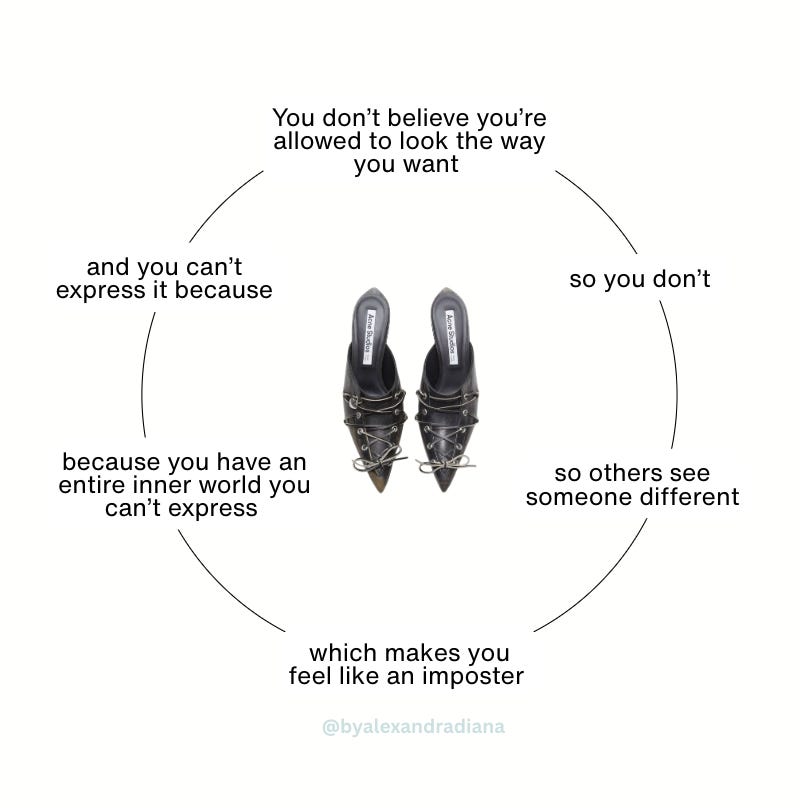
II. Avoidance thrives off insecurity
The behavior that protects you from judgment today becomes the behavior that teaches you to fear judgment tomorrow.
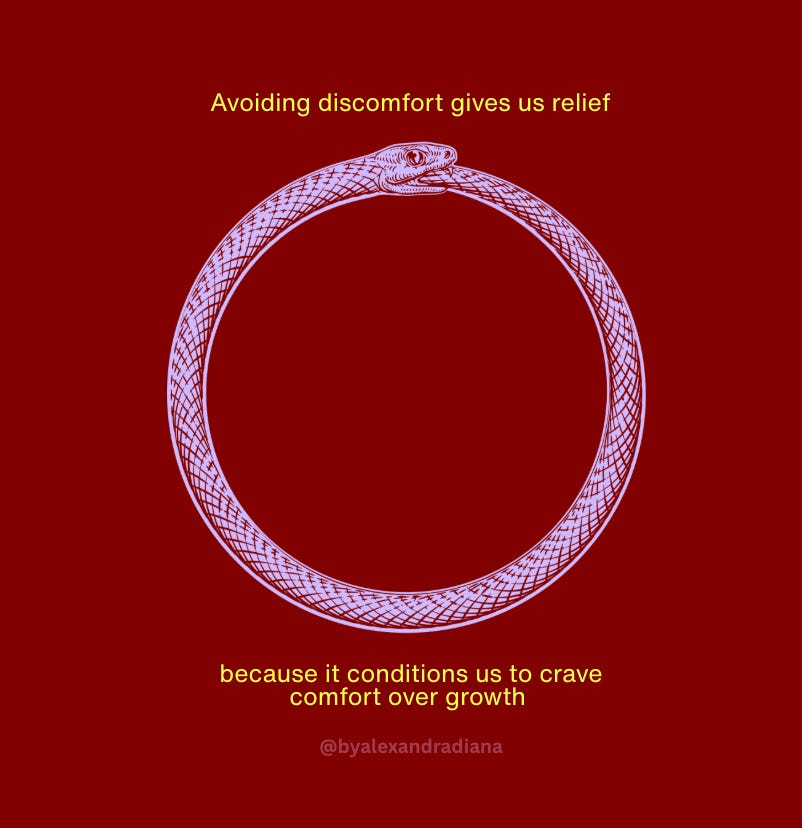
Avoidance provides immediate relief, while simultaneously strengthening the behavior that produced it. Each time you avoid something that makes you feel uncomfortable, your brain is conditioned to do it again because it’s been rewarded with comfort.
Watering down your appearance to avoid potential criticism or negative judgement may offer short-term psychological comfort, yet the long-term psychological damage is that the very act of concealment repeatedly reinforces that visibility is something to fear. The behavior you adopted to reduce feeling insecure will become the very thing that sustains your insecurity.
Mowrer, O. H. (1947). On the Dual Nature of Learning: A Re-interpretation of "Conditioning" and "Problem-Solving." Harvard Educational Review.
III. There’s no such thing as "not trying"
The desire to avoid attention is still a relationship with attention.
One of the oldest ideas in social psychology is that the self does not develop in isolation. We continuously imagine how we appear to other people, anticipate their judgments, and adjust our behavior accordingly. Whether those judgments ever materialize is almost beside the point. The expectation alone is often enough to shape behavior.
The more we try, the more our effort betrays us. There is no such thing as “not trying” because humans are always regulating themselves in anticipation of how they’ll be perceived.
Choosing not to stand out is no less socially meaningful than choosing to stand out, because both behaviors are organized around anticipated evaluation: One risks being called vain, while the other hopes to avoid accusation altogether.
So since there’s no exit, you might as well wear what you like then, no? :)
Leary, M. R., & Kowalski, R. M. (1990). Impression Management: A Literature Review and Two-Component Model. Psychological Bulletin, 107(1), 34–47.
Much of this argument rests on a broader question: what happens when we behave as though we’re always being watched?

The strange paradox of looking ordinary is that what begins as freedom from judgment often becomes obedience to it.
Don’t be too much, don’t be misunderstood, don’t look like you tried. Before long, you mistake restraint for character, and fear for virtue.
Nobility isn’t the refusal to be seen. It’s the refusal to betray yourself in order to be accepted. Scrape the palatable conglomerate of the masses off your tongue, and begin again.
With great personal aesthetic,
Alexandra Diana


This is a well crafted piece. Insightful! Thanks.